30 January 2026
How to source for roles that don't exist yet
Article created in collaboration with Cristina Podgurschi-Popa , Technical Sourcing Partner EMEA at Adobe.

When a hiring manager sends over a requisition for a role that barely exists in the market, standard sourcing playbooks fall apart. No established talent pool. No competitor benchmarks. No clear search strings to rely on.
Cristina, recently faced exactly this challenge when tasked with finding Forward Deployed Engineers across Europe - a role so new that initial LinkedIn searches returned thousands of fake profiles and almost no real candidates.
What followed was a masterclass in investigative sourcing that any recruiter facing ambiguous roles can learn from.
Why emerging roles break traditional sourcing
For technical sourcers, new job titles create a familiar problem: the data is dirty, the definitions are unclear, and hiring managers often can’t articulate exactly what they need because the role hasn’t been done before.
Traditional sourcing won’t fix these problems, but a research-first approach can cut through the noise and surface candidates that keyword searches miss entirely. As Cristina explains,
“When I first searched for Forward Deployed Engineer, LinkedIn gave me 3,000 results in Germany alone. That seemed promising, until I realized almost all of them were fake accounts.”
The key is treating sourcing as investigation, not just searching.
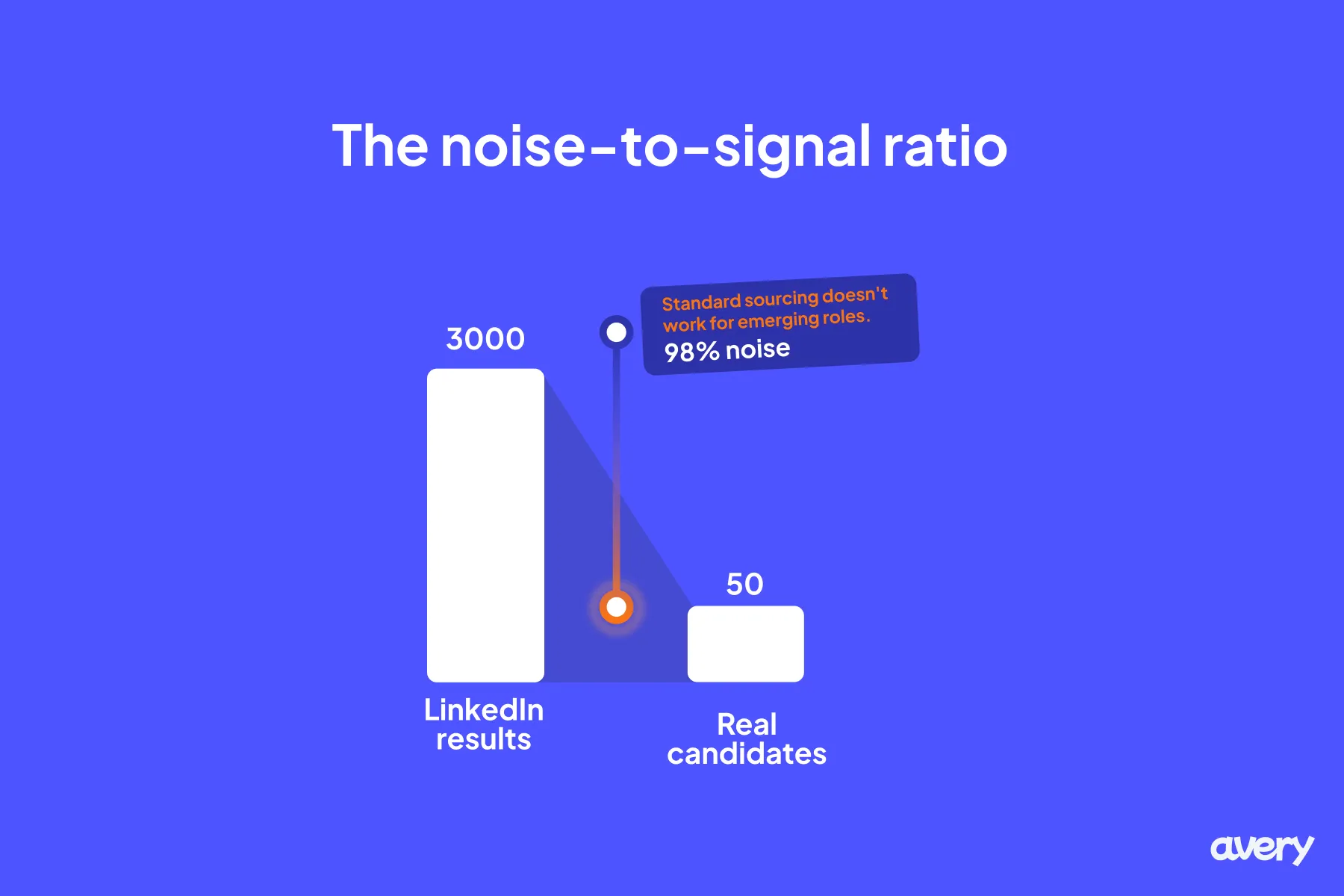
Cristina’s initial LinkedIn search returned thousands of results. Almost all were fake profiles.
Playbook: Cristina’s research-first sourcing framework
Validate the data before you trust it
Cristina’s initial search returned profiles with FDE titles at companies like Nestlé and L’Oréal - organizations with no logical need for this specialized technical role. The profiles looked genuine: complete job descriptions, professional photos, proper formatting.
“It took me a while to understand these were dupes,” she says. “Out of 3,000 results, only about 50 were real candidates.”
When sourcing for emerging roles, expect the noise-to-signal ratio to be catastrophic. Standard Boolean searches won’t save you.
Study what competitors are actually doing
When direct sourcing fails, reverse-engineer what’s working elsewhere.
Cristina tracked Salesforce, who had started hiring FDEs a few months before Adobe. Their approach revealed something important: they largely gave up on external hiring.
“They retrained in-house solutions consultants and solutions architects,” she explains. “People already in pre-sales and post-sales roles. They paired them with engineers, gave them proper training, and promoted them into FDE positions.”
This insight told Cristina two things: the external talent pool was genuinely thin, and the FDE skillset was a hybrid of consulting and engineering. Both would shape her strategy.
Go to primary sources
Here’s where Cristina’s approach diverged from typical sourcing methodology. Instead of tweaking search strings, she went looking for first-person accounts from people who had actually done the job.
“I searched for articles written by ex-Forward Deployed Engineers who worked at Palantir,” she says. Palantir essentially invented the FDE role, initially deploying technical talent into military and government contexts before expanding into enterprise tech.
What she found were personal blogs and detailed career retrospectives. Some articles took 30 minutes to read - comprehensive first-person accounts of what the role actually requires.
“They explained how they did it, what was really important. In Palantir’s case, it was acting fast and making independent decisions. Originally, these people were deployed into high-pressure situations. There was no corporate bureaucracy. No approval chains. You had to decide on your own.”
Translate research into prioritized requirements
The research transformed Cristina’s understanding of what Adobe actually needed. An FDE isn’t just a software engineer with client-facing skills. They’re autonomous problem-solvers who become the single point of contact for complex enterprise implementations.
“We needed somebody independent, senior enough to make their own decisions without relying on anyone else,” Cristina explains. “When deployed to a client, they won’t escalate to support - they are the support.”
This clarity allowed for a critical recalibration with the hiring manager. The priority stack shifted:
- Engineering background - non-negotiable foundation
- ML/AI experience - core technical competency
- Autonomous decision-making - the insight from Palantir research
- Client-facing experience - consulting DNA
- Product knowledge - deprioritized as learnable on the job
“We gave up on requiring product knowledge,” Cristina says. “That’s something they can learn. What they can’t learn is how to operate independently in high-pressure client situations.”
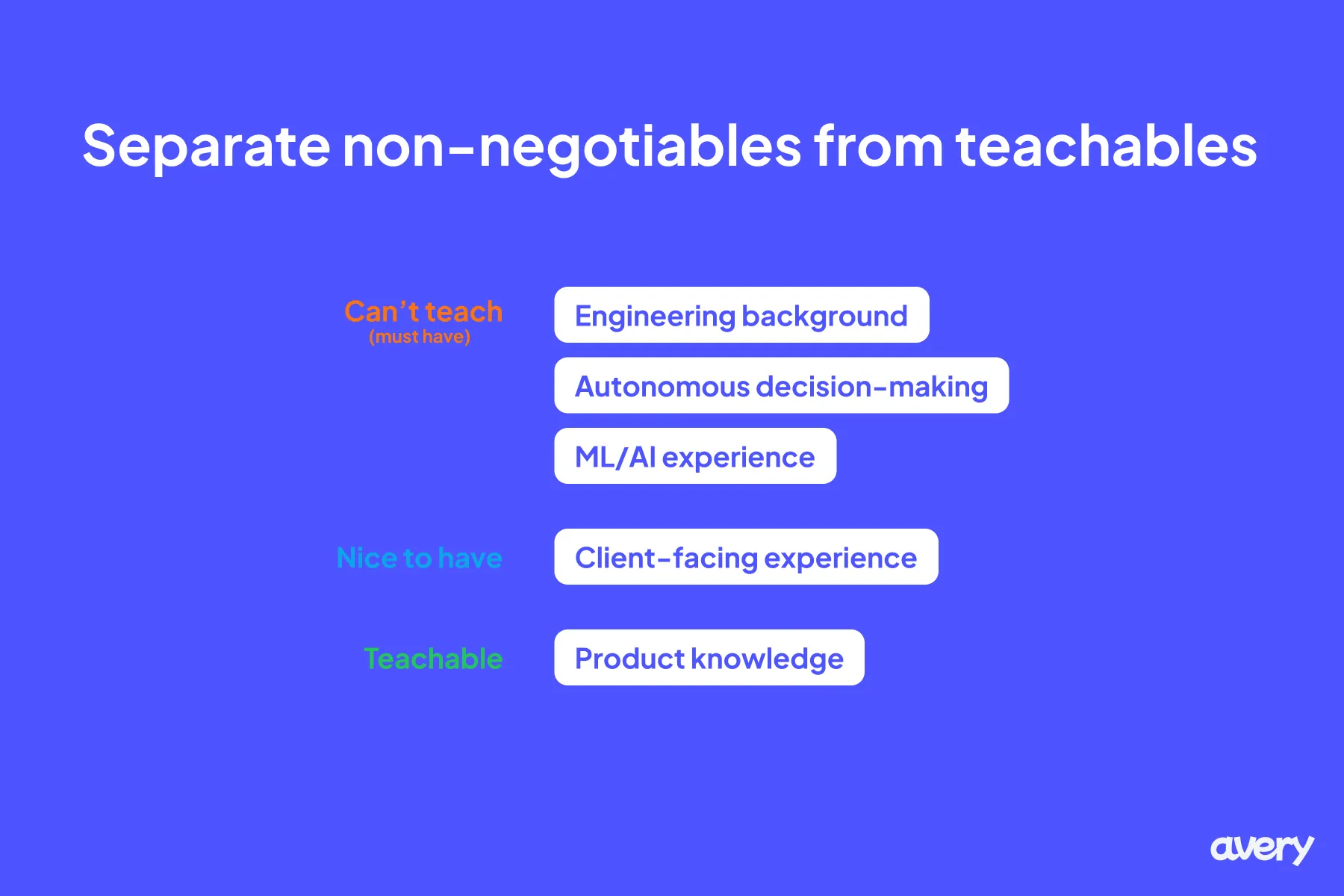
The priority framework Cristina built with her hiring manager to cut through ambiguity.
Build the priority framework with hiring managers
This methodology becomes transferable across any ambiguous role.
“When you get a new role, the first thing you need from the hiring manager is what’s important, what’s less important, and what’s not important at all,” Cristina explains. “You get the priorities. Then you work from there.”
The framework is deceptively simple: must-have skills get ranked by importance, nice-to-haves get deprioritized, and anything teachable moves to the bottom.
“You never find an ideal candidate. And if you find somebody who matches 100% of your job description, they won’t stay - there’s no room for them to grow. Usually you hire for 30% less capability and grow them into the position.”
Best practices: sourcing for roles that don’t exist yet
Cristina’s experience offers key lessons for sourcers facing ambiguous or emerging roles:
- Don’t trust initial search results. Especially for new titles, the data is dirty. Expect 90%+ noise.
- Study competitors. Not to copy them, but to understand what’s actually possible in the market.
- Find primary sources. The people who’ve done the job will tell you what really matters.
- Translate research into priorities. Work with the hiring manager to distinguish must-haves from teachables.
- Accept that perfect doesn’t exist. Hire for potential, not checkboxes.
“I didn’t do this with AI,” Cristina emphasizes. “I read everything with my own brain. There was no shortcut.”
That’s not an argument against using tools. It’s a reminder that when sourcing for genuinely new roles, the research phase can’t be automated. The pattern recognition has to come first. Only then can you build a search strategy that actually works.

Why hiring for potential beats hiring for checkboxes
Conclusion
Cristina’s system shows that sourcing for emerging roles requires investigation before execution. A research-first approach, combined with disciplined prioritization, can surface candidates that keyword searches miss entirely.
Your move
Still relying on LinkedIn alone? Spending hours on manual sourcing while roles stay open for months?
The candidates you need are out there. The question is whether you’ll find them first, or your competitors will.
Get started with Avery and find candidates your competitors are missing →