28 November 2025
Success story: Timetohire
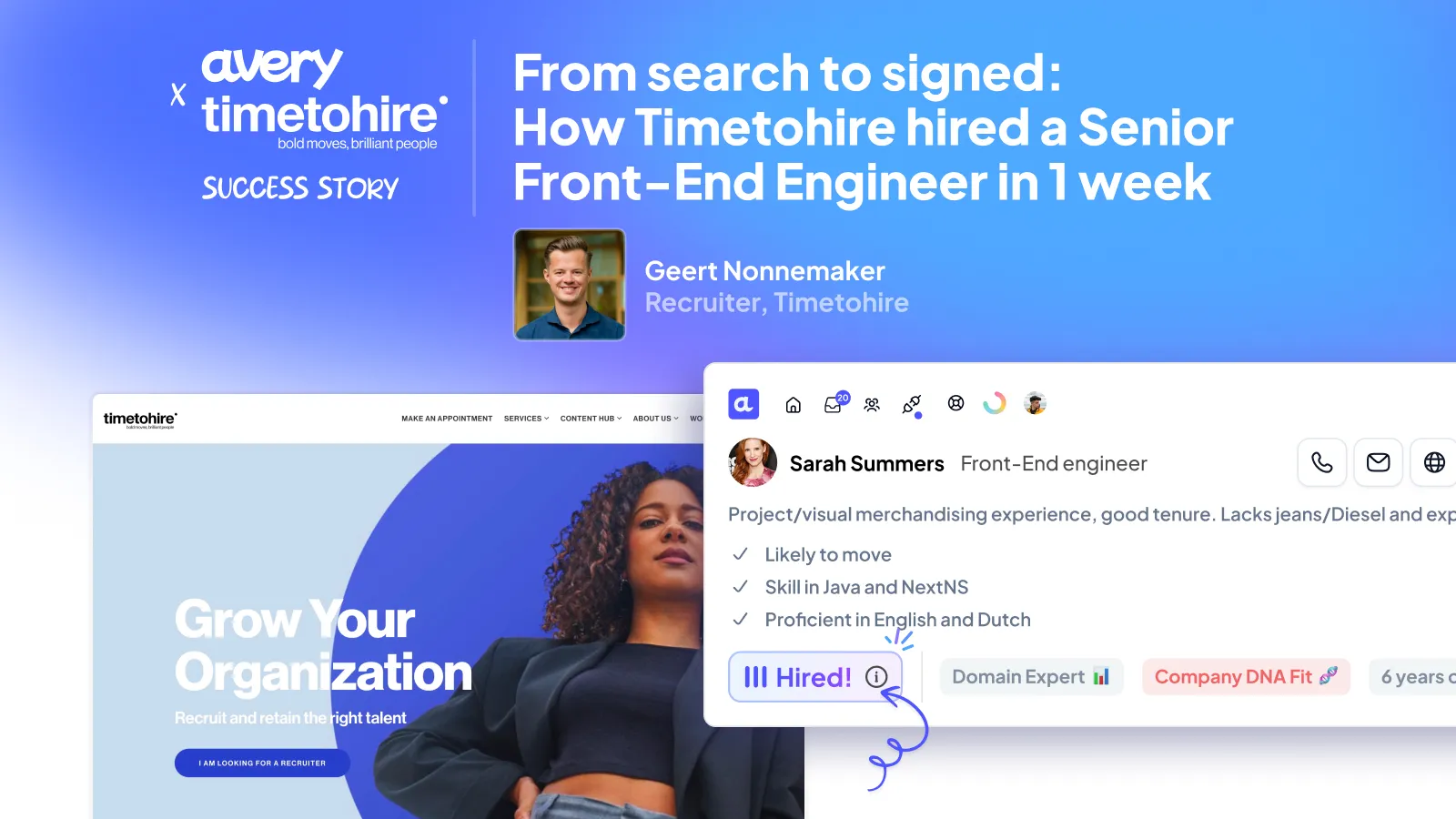
From search to signed: How Timetohire hired a Senior Front-End Engineer with Avery, in just 1 week
The company
Timetohire is a leading recruitment agency in the Netherlands that works with demanding clients , companies where “good enough” isn’t good enough. Their reputation depends on delivering quality candidates fast. When a client says they need a senior engineer, they mean someone who can walk in and contribute from day one. Not someone who needs three months to ramp up.
That pressure flows directly to the recruiters. Every role is a race against time, client expectations, and competing agencies. The ones who find the right people first, win.
Vaccancy: Senior Front-End Engineer
The requirements were clear: deep engineering experience, strong React and TypeScript skills, and the ability to hit the ground running. The client wasn’t interested in potential, they needed proven capability.
For an experienced recruiter like Geert Nonnemaker, this was familiar territory. He knew how to find senior engineers. He’d done it dozens of times.
But knowing how to search and actually finding the right person are two different things.
The problem: LinkedIn’s blind spots
Geert started where most recruiters start: LinkedIn. The platform is the default for a reason because It’s where the candidates are. But it’s also where LinkedIn’s limitations become painfully clear the moment you need to find someone specific.
LinkedIn searches for keywords. It doesn’t understand skills.
If a candidate hasn’t written “React” and “TypeScript” explicitly on their profile, they don’t exist, at least not to LinkedIn’s search algorithm. It doesn’t matter if they’ve spent five years building complex front-end applications. It doesn’t matter if their actual experience makes them a perfect fit, with no keywords, they got no visibility.
Geert could spend hours scrolling through profiles, finding plenty of people who looked right on paper but didn’t have the depth the role required. Meanwhile, genuinely strong candidates, the ones who could actually do the job, stayed hidden because they hadn’t optimized their profiles for recruiter searches.
The response rates didn’t help either.
Even when Geert found promising candidates, getting them to respond was another challenge. LinkedIn outreach had become noise. Candidates received so many generic messages that even well-crafted ones got ignored. Timetohire’s response rate on LinkedIn outreach hovered below 20%. That meant for every five messages sent, four went nowhere.
With client pressure mounting and a timeline to meet, Geert needed a different approach.
The experiment: trying Avery
Timetohire had recently started piloting Avery, our AI-powered hiring intelligence platform that promised them to find candidates traditional search missed. Geert decided to put it to the test on this role.
He uploaded the job description and started sourcing.** Within first hours, he had 80 potential candidates.** Not 80 random profiles to review. Eighty people that Avery had identified as genuine fits for the role: scored, ranked, and explained.
To put that in perspective: using LinkedIn, Geert would typically spend an entire week to build a shortlist that size. Avery compressed that into a single morning. But the quantity wasn’t the breakthrough. The quality was.
The candidate LinkedIn would have filtered out
Among the 80 candidates Avery surfaced, one stood out. His profile showed deep engineering experience, a strong trajectory, and the kind of technical foundation that suggested he could handle a senior front-end role.
There was just one problem: he didn’t list React or TypeScript anywhere on his LinkedIn profile.
In a traditional keyword search, he would have been invisible. Filtered out before Geert ever saw his name. Another strong candidate lost to LinkedIn’s literal-minded algorithm.
Avery didn’t work that way, as instead of matching keywords, Avery analyzes the candidate’s actual background, the technologies he’d worked with, the complexity of his projects, the arc of his career. It recognized transferable skills and stack familiarity even when the specific buzzwords weren’t listed.
The platform flagged him as a strong match and explained why:
“These skills are not explicitly listed, but he has deep experience and transferable skills that make him a strong fit for this senior position.”
Geert had a choice to trust the algorithm and reach out, or stick to conventional wisdom and skip a candidate without the “right” keywords. He decided to trust the signal.
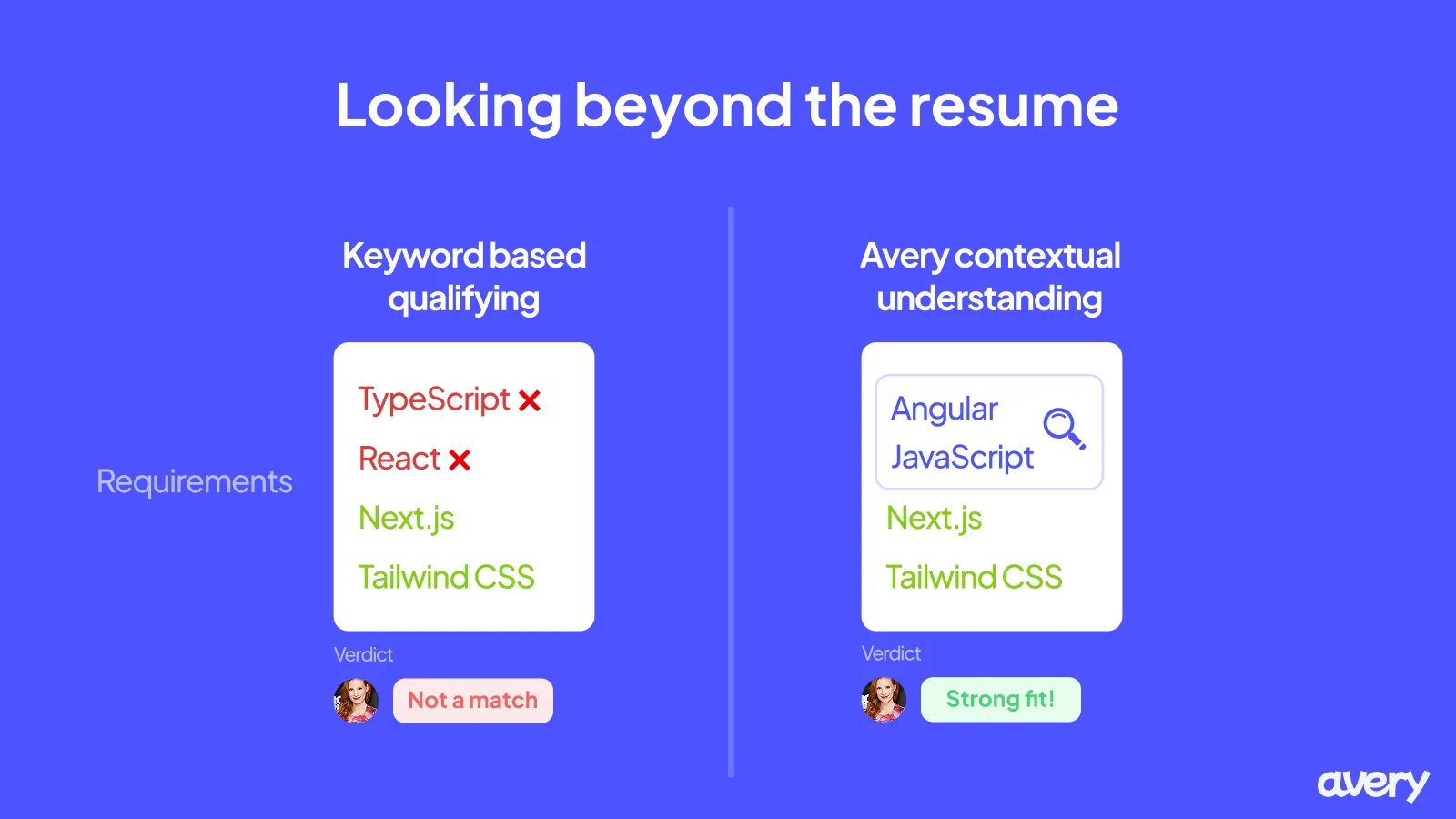
Traditional search often can miss valuable contextual data
The outreach: zero friction
Avery didn’t just find candidates, it wrote the outreach messages.
Each message was tailored to the specific candidate: their background, their career story, why this particular role at this particular company might interest them. Not a generic template with a name swapped in, nut an actual personalization at scale.
Geert reviewed the message Avery generated for the standout candidate. It was good. He didn’t change a word.** Click. Send.**
He did the same for nearly all 80 candidates on the shortlist. Same day, no copywriting, and no agonizing over phrasing. Just reach out, move on, let the responses come in.
The results: one week to offer
The responses came in fast.
Within the first week:
- 7 screening calls scheduled
- 4 candidates moved to first interviews with the client
- 1 clear front-runner emerged, the candidate without React or TypeScript on his profile
The screening calls weren’t a slog through unqualified applicants. The candidates Avery surfaced were genuinely qualified. The conversations were substantive. Geert could focus on evaluating fit rather than filtering out noise.
The front-runner impressed in interviews, which made the client move quickly and an offer went out.
One week from search to signed offer! For context: Timetohire’s typical timeline for senior engineering roles runs weeks to a month. This role closed in seven days and the client was beyond impressed.
Results
| Metric | Result | Time to shortlist | Same day | Candidates shortlisted | ~80 | Screening calls scheduled | 7 (within first week) | First interviews | 4 (same week) | Time to offer | 1 week | Outcome | Offer accepted ✓
What changed: response rates that actually work
The response rate shift deserves its own spotlight. ** LinkedIn outreach: below 20%.** Four out of five messages ignored.** Avery-powered outreach: 40-50%.** Nearly half of candidates responding.
That’s not a marginal improvement. That’s a fundamental change in how sourcing works.
The difference comes down to relevance. When candidates receive a message that actually speaks to their background, that shows the recruiter (or the AI) understood who they are and why this role makes sense, they engage. Generic spray-and-pray outreach gets deleted. Personalized, intelligent outreach gets responses.
For a recruitment agency, that math changes everything. Fewer messages needed. More conversations started. Faster pipelines. Happier clients.
In their own words
“Avery really pushed me towards the right candidates. I sent a message written by Avery, didn’t even have to think about what to write. Just clicked send. One week later I had the call, and now he’s joining our team.”
Geert Nonnemaker, Recruiter at Timetohire
Why this hire was different
Avery found a candidate that LinkedIn couldn’t see. The winning hire didn’t have the right keywords on his profile. Any traditional search would have missed him completely. Avery’s intelligence layer recognized the fit anyway, and that recognition turned into a placement.
Speed didn’t sacrifice quality. One week sounds fast because it is fast. But the screening calls were strong. The candidates were qualified. The client was impressed. Avery compressed the timeline without flooding the pipeline with noise.
The recruiter’s job changed. Geert didn’t spend his week writing messages and scrolling through LinkedIn. He spent it having conversations with qualified candidates and moving the process forward. The AI handled the grunt work. The human handled the judgment calls.
Skepticism turned into conviction. Like most recruiters, Geert had doubts about AI-driven recommendations. Could an algorithm really identify candidates better than an experienced human? The answer, proven by results: yes, especially for the candidates that keyword searches systematically miss.
The bigger picture
This wasn’t a one-time experiment for Timetohire. After the pilot succeeded, they scaled their use of Avery across more roles.
Geert went from skeptic to power user. The platform didn’t replace his expertise, it amplified it. He still makes the judgment calls. He still runs the conversations. He still closes the deals. But now he starts from a position of strength: a curated list of genuinely qualified candidates, reached with personalized outreach, in hours instead of weeks.
For a recruitment agency where speed and quality determine success, that’s not a nice-to-have. It’s a competitive advantage.
The takeaway for Recruiters
LinkedIn is a starting point, not a complete solution. Its keyword-based search systematically filters out strong candidates who haven’t optimized their profiles for recruiter visibility. Its crowded inbox means even good outreach often gets ignored.
The recruiters who win aren’t the ones who work harder within those limitations. They’re the ones who find ways around them.
Geert found a Senior Front-End Engineer in one week, a candidate that traditional search would have missed entirely. He did it with less effort, higher response rates, and a faster timeline than his usual process.
The question isn’t whether AI-powered sourcing works, the question is whether you’ll use it before your competitors do?