How Dani Nguyen books 15+ interviews a week while sourcing less than an hour a day
Article created in collaboration with Dani Nguyen, Senior Tech Recruitment Consultant in Doghouse Recruitment
.jpg)
Most recruiters I meet spend 10-15 hours a week sourcing. Then they wonder where the week went.
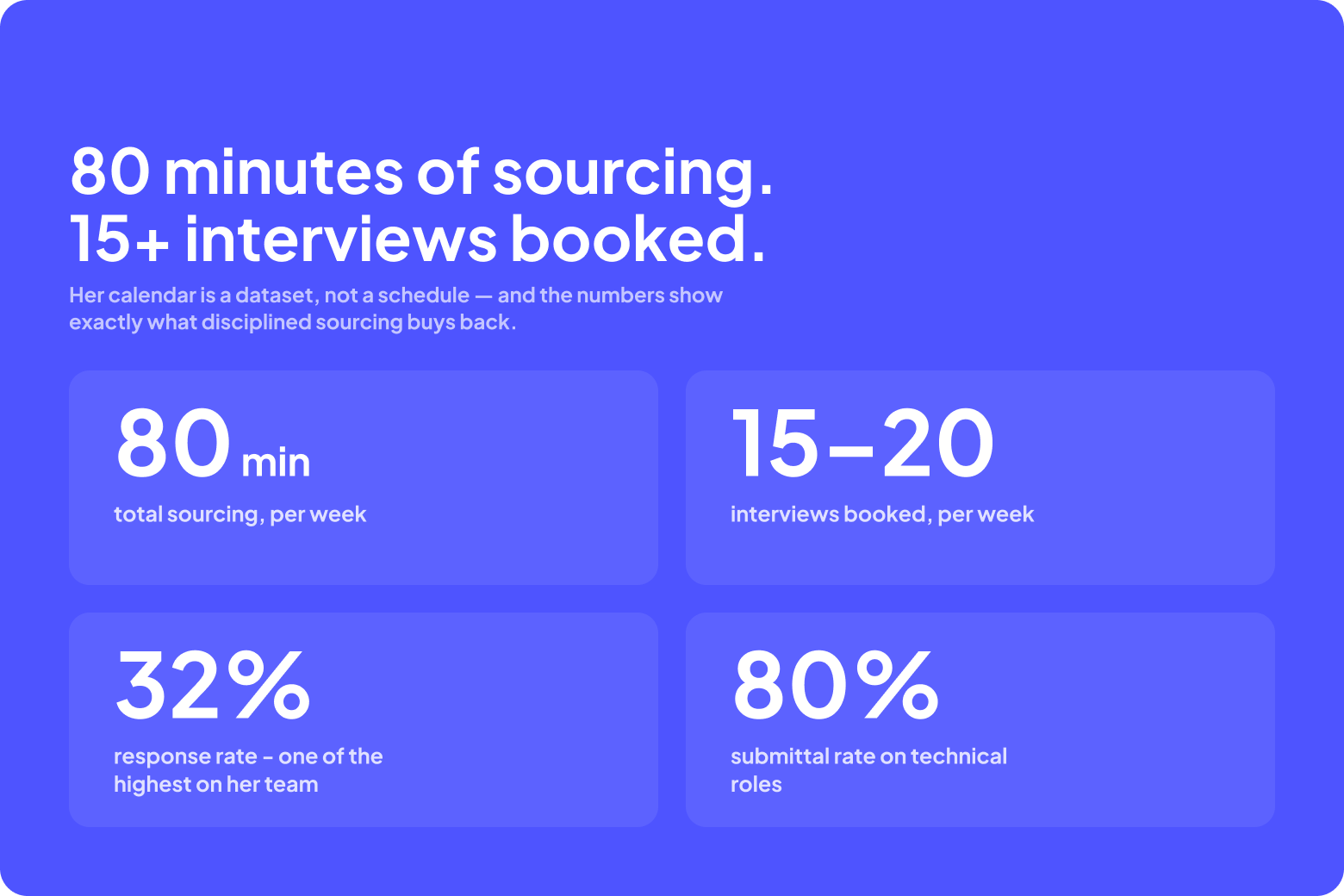
Last week I sat down with Dani Nguyen, a recruiter at Doghouse, and asked her to show me exactly how she works. Her calendar showed roughly 80 minutes of sourcing across the entire week. Her output: 15-20 interviews booked, a ~32% response rate (one of the highest on her team), and submittal rates of up to 80% on technical roles.
That's not luck. It's a system. Here's how it works.
Her calendar is a dataset, not a schedule
Dani color-codes everything: client meetings, candidate calls, sourcing blocks, admin, even the gym. Then she exports her calendar and analyzes it - how many hours per year on sourcing, on screening, on admin.
Most recruiters feel busy. Dani knows where her time goes. You can't optimize what you don't measure - and she measures everything, down to manually collecting her own salary data points per role so she can push back on unrealistic briefs with evidence.
She batches ruthlessly
Every context switch costs you ~15 minutes of ramp-up time. Dani's answer: never mix modes.
When she sources, everything else is muted - 30 minutes, in and out. When she does admin, she sits down and clears it in one block. No half-sourcing while checking messages. The result is that she does less admin than most of her peers, not because she has less of it, but because she never lets it leak across her day.
Three touch points, then move on
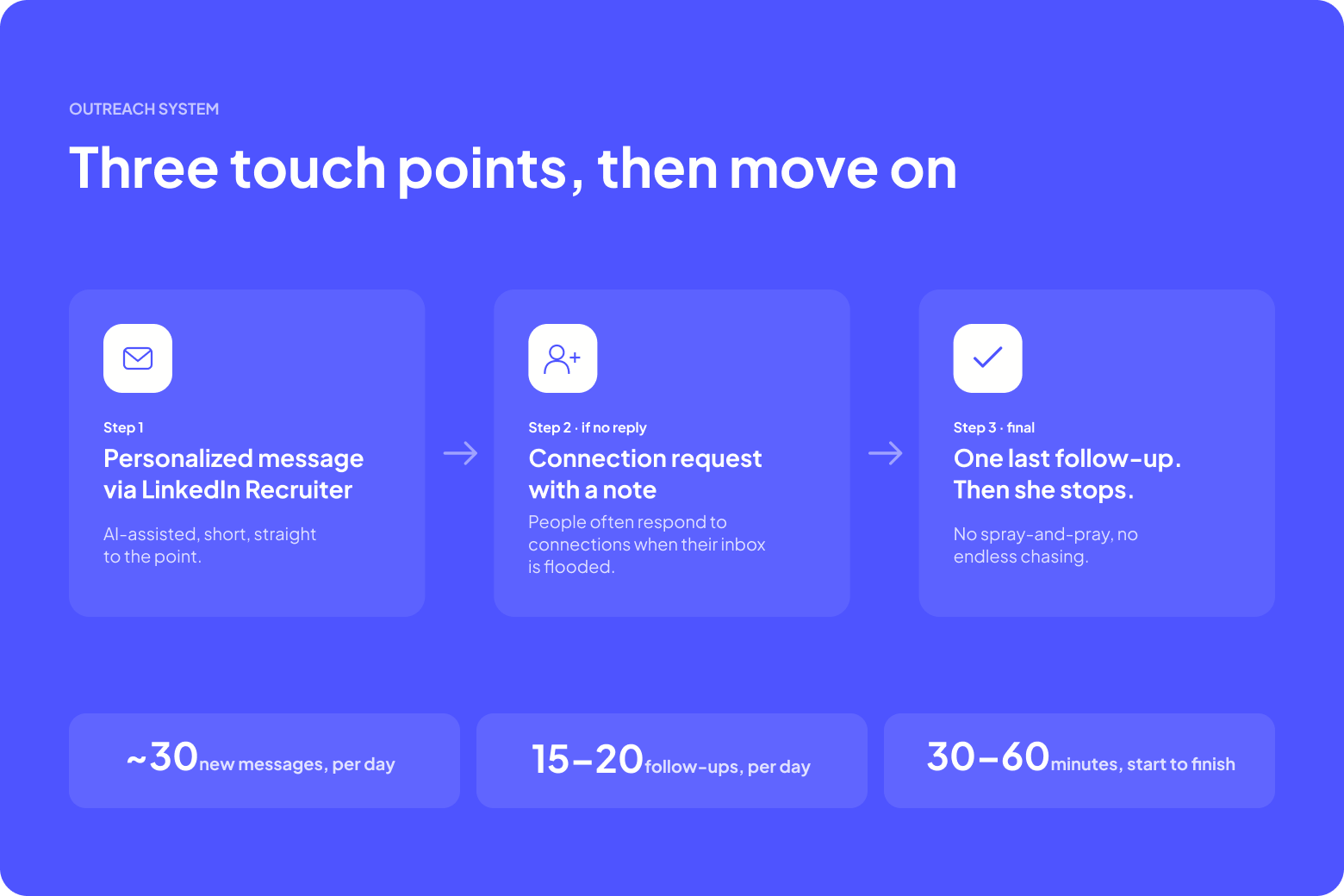
Her outreach sequence is simple and disciplined:
- Personalized message via LinkedIn Recruiter (AI-assisted, short, straight to the point)
- Connection request with a note on their public profile if no reply - because people often respond to connections when their inbox is flooded
- One final follow-up. Then she stops.
Around 30 new messages a day, 15-20 follow-ups, all inside that 30-60 minute window. No spray-and-pray, no endless chasing.
Her network is a filter, not a trophy
Dani has 400+ pending connection requests she'll never accept. Her rule: only connect with people she'd genuinely want to work with - including candidates who said no.
Why? Because when she posts a role, it reaches the right people, not the most people. Her first-degree network is a pre-qualified talent pool. Every rejection today is a warm candidate in two years.
Quality screens beat volume screens
She reviews 50-60 profiles to advance ~30. She'd rather screen 10 candidates and submit 8 than screen 20 and submit 8. Her filter runs before outreach - years in the specific role, tenure patterns, salary alignment - so she never spends a call discovering a mismatch she could have spotted in ten seconds.
She's honest about money
No hardball, no games. If a candidate wants €100K and the role pays €80K, she tells them to stay where they are. It costs her a submission occasionally. It earns her a reputation - and candidates who come back.
She uses AI without ego
"Some recruiters are prideful about not using AI. It's going to be the future - you might as well." She compared her own writing against AI-assisted writing, kept what performed better, and let the response rate settle the debate. It did: hers is one of the highest on the team.
The takeaway
Dani's secret isn't working harder - she's happy to put in long days when needed. It's that sourcing is an input, not the job. The job is talking to candidates: prepping them, screening them, moving them forward. Everything else gets compressed, batched, templated, or automated.
80 minutes of sourcing. 15+ interviews. That's what efficient looks like.
Your move
Roles stay open for months. Competitors move faster. The candidates you need are out there - the question is who finds them first.
Get started with Avery and find candidates your competitors are missing →

.png)