12 May 2026
AI Recruitment Tools: Three Moves That Actually Matter for Founders
Founders don't need a recruiting stack; they need three capabilities in this order: salary benchmarking, AI-assisted sourcing, and automated screening.
The short version
You don’t need a recruiting stack. You need three capabilities, in this order:
- Salary benchmarking. Stop losing candidates to offers you could have fixed in ten minutes.
- AI-assisted job descriptions and sourcing. Fix what you’re putting into the funnel.
- Automated screening and fit scoring. Compress days of resume review into hours.
Each delivers value standalone. Together, they materially cut time-to-hire and offer-stage losses. Start with Move 1. It takes 30 minutes to test on one real role.
One thing to flag up front: most of the published statistics on AI in recruiting come from HR teams and recruiters at larger companies. You’ll see those numbers throughout this article. Your results as a solo hiring founder will look different. We’ll be honest about that as we go.
Why this matters now
Hiring is the highest-leverage decision a founder makes. A great early hire compounds across every function they touch. A bad one drains your attention, slows everything else down, and at the extreme it can sink the company.
Sam Altman puts it bluntly: “the cost of getting an early hire wrong is really high… a lot of companies with very bad first hires end up never recovering.” Index Ventures’ Scaling Through Chaos - built on 200,000+ career profiles across 210 top startups - backs the same conclusion: early mis-hires disproportionately damage small teams.
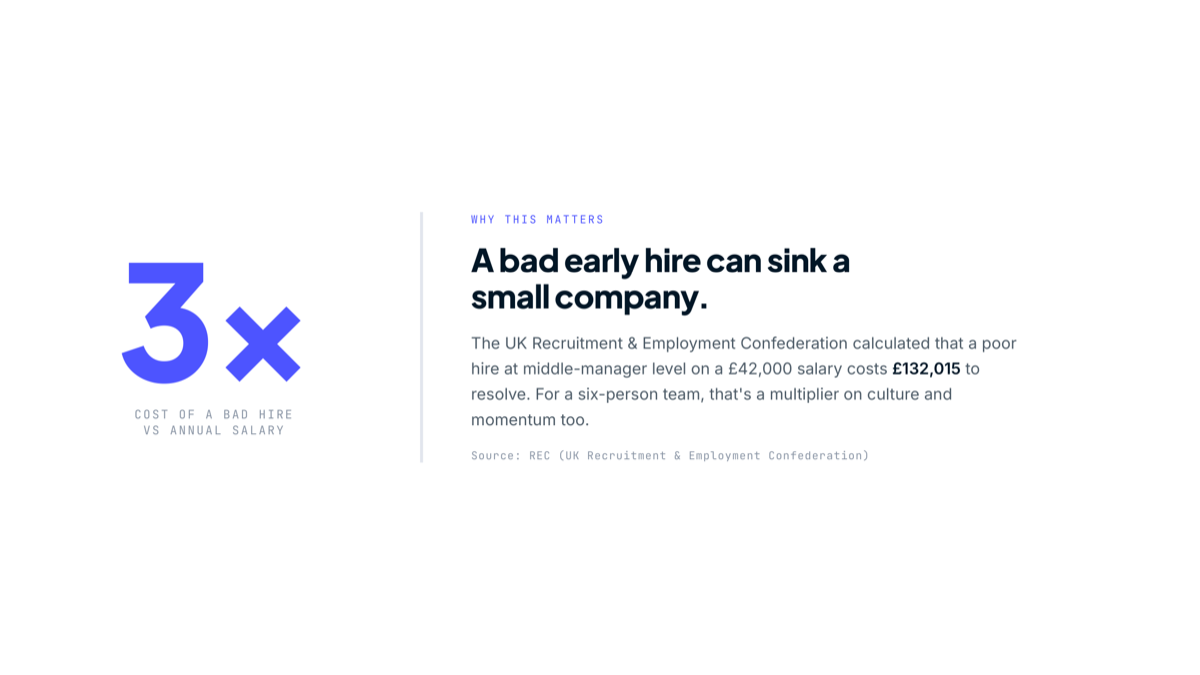
The financial floor on a bad hire is well-documented. The UK Recruitment & Employment Confederation’s Perfect Match report calculated that a poor hire at middle-manager level on a £42,000 salary cost a business £132,015 to resolve once wasted salary, training, lost team productivity and re-hire were included. Roughly three times annual salary. For a founder with a six-person team, the multiplier on culture and momentum makes that number a floor, not a ceiling.
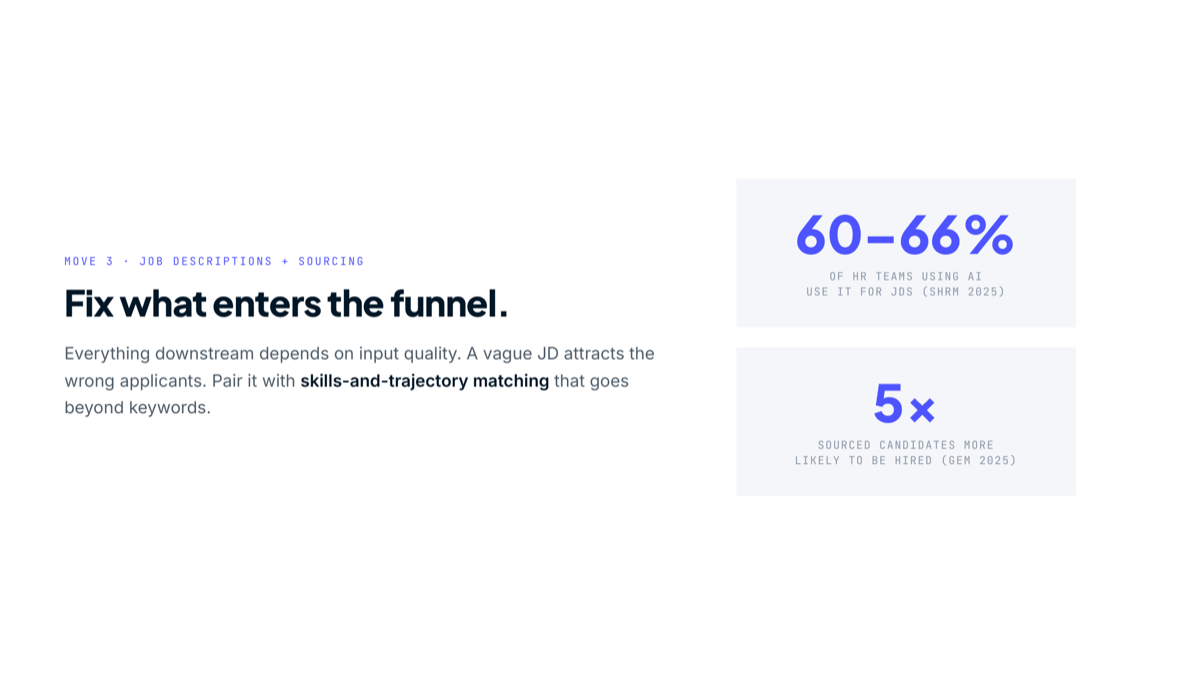
Most founders approach hiring with a job board, a LinkedIn search and gut instinct. The evidence says this leaks badly. Gem’s 2025 Recruiting Benchmarks (across 140M+ applications) found that job boards and social channels generate 49% of applications but fewer than 25% of hires, while sourced (outbound) candidates are five times more likely to be hired than inbound applicants.
The risk isn’t adopting AI too early. It’s spending your time on manual work while your competitors reach your candidates first.
The three moves
Move 1: Stop losing candidates at the offer stage
What it does. Tells you the right compensation range before you make an offer, so you close on the first attempt.
This is the move most founders skip. It’s also the one that protects everything else you’ve invested.
You’ve written a sharp job description. You’ve screened efficiently. You’ve interviewed well. Then you lose your top candidate because your offer is 15% below market, or you overpay by 20% because you had no data to anchor to. Both are expensive. The first costs you weeks of restarted effort. The second costs you runway.
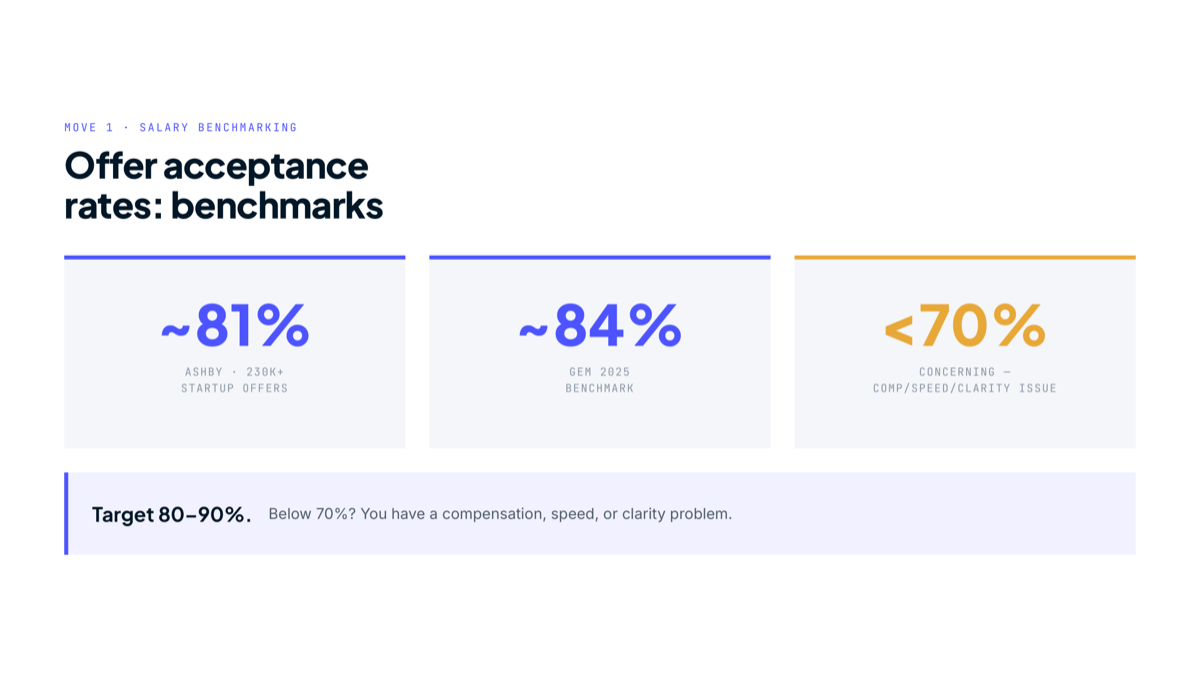
A common founder misconception: that an above-70% offer acceptance rate is healthy. The actual benchmarks say otherwise. Ashby’s data across 230,000+ startup offers (Jan 2021 to Mar 2024) puts the typical startup offer-acceptance rate at around 81%; Gem’s 2025 data lands at ~84%; common HR rubrics call 90%+ excellent, 80% healthy, and below 70% concerning. If you’re at 70%, you have a compensation, speed or role-clarity problem. Target 80-90%.
For European founders, salary benchmarking tools that work specifically on European data matter. Ravio (London-based, 1,500+ company HRIS integrations, 50+ countries, covers base + equity + variable + benefits) and Figures.hr (HRIS-integrated European base + variable pay, with Mercer partnership) are the strongest options. Pave is powerful but ~67% of its data is from US/Canada and only ~14% from European organisations, so its European numbers are modelled rather than directly observed. For tech roles, Levels.fyi is a useful free cross-check, though it’s self-reported and skews North American.
This isn’t about removing negotiation. It’s about entering it with real numbers. Especially when you’re a startup competing against companies with larger budgets, knowing exactly where your offer stands, and where equity or flexibility compensates, is what closes the gap.
How you know it’s working. Your offer acceptance rate is 80% or above. Candidates don’t express surprise at your compensation range. You can defend your number if they push back.
Move 2: Fix your inputs
What it does. Produces job descriptions that attract the right people, and sources candidates beyond what LinkedIn’s keyword filters surface.
Everything downstream depends on input quality. A vague job description attracts the wrong applicants. Wrong applicants mean more screening time, more interviews, more restarts. SHRM’s 2025 Talent Trends found roughly 60-66% of HR teams using AI in recruiting use it to write job descriptions. That’s a signal it works fast and the work is unambiguous enough for a machine to help with.
AI-assisted job description tools pull from market data to flag requirements that unnecessarily narrow your pool, and suggest language that resonates with your actual target profile. Pair that with 7-dimension matching that goes beyond keyword search - which can match on skills and trajectory, not exact title - and you’re no longer limited to whoever LinkedIn’s algorithm decides to surface.
A concrete example from our own customers. Timetohire, a Dutch recruitment agency, had stalled on a Senior Front-End Engineer search. LinkedIn keyword search wasn’t producing relevant candidates. Switching to AI-powered sourcing inside Avery, they closed the role in one week. The unlock wasn’t speed for its own sake. It was reaching a candidate the keyword search had been quietly missing.
How you know it’s working. Your applicant pool gets noticeably more relevant within the first posting cycle. You’re drafting a complete job description in under 30 minutes. Your sourced-candidate response rate goes up.
Move 3: Stop reading 120 resumes
What it does. Gets you from “applications received” to “top 5 candidates identified” in hours, not days.
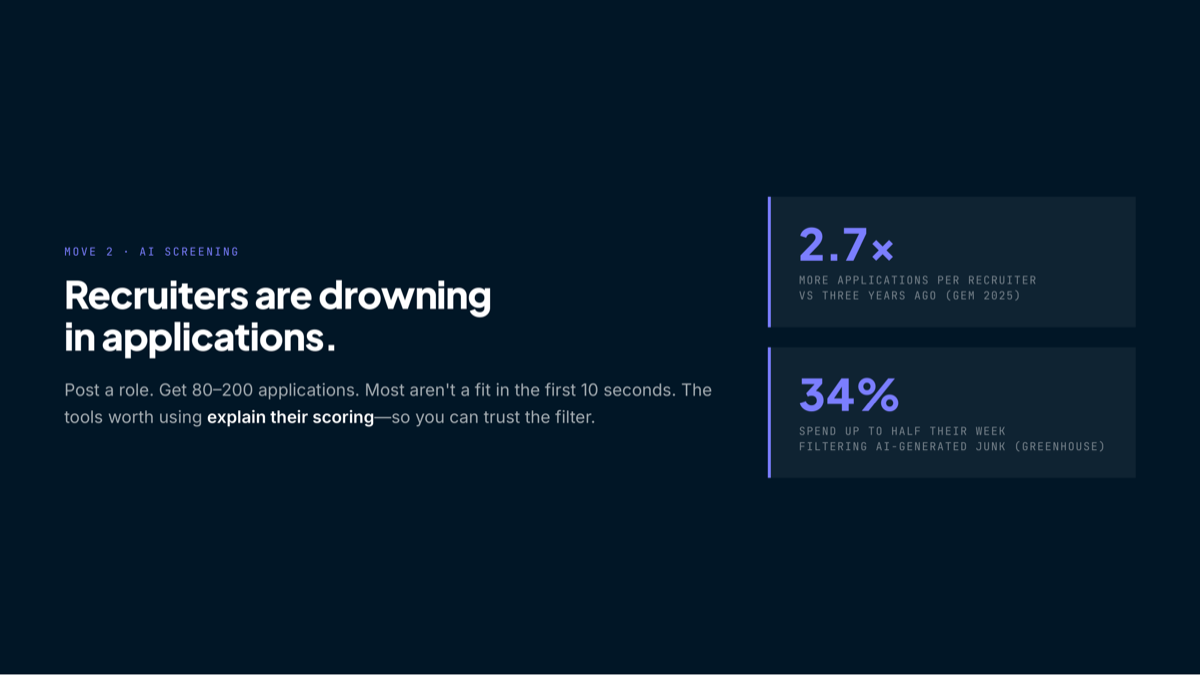
Screening is where founders lose the most time. You post a role, receive 80 to 200 applications, and spend half a day reading resumes, most of which are clearly not a fit within the first ten seconds. The volume problem has gotten worse, not better: Gem’s 2025 benchmarks show recruiters now handle 2.7x more applications than three years ago, and Greenhouse’s 2026 AI Hiring Report found 34% of recruiters spend up to half their week filtering spam and junk applications generated by candidate-side AI.
LinkedIn’s Future of Recruiting 2025 study (n=1,271 talent acquisition professionals across 23 countries) reports that generative-AI users save “about 20% of their work week, a full workday saved weekly.” Worth a caveat: that’s recruiters with weekly recruiting workloads. A founder who hires twice a year doesn’t have 20% of a workweek to recover. What a founder gets is concentrated relief during the active hiring period - the days you’re drowning in resumes turn into hours.
AI screening tools score candidates against your role criteria and surface a shortlist. The ones worth using explain their scoring, so you can calibrate your judgment, not just trust a black box. That matters both for your confidence in the output and for the bias and legal exposure we’ll cover later.
Three questions to evaluate any screening tool:
- Does it score against criteria you define?
- Does it explain why a candidate scored the way they did?
- Can it plug into your existing workflow without a three-month implementation?
If all three are yes, test it on a live role. If not, it’s built for someone else.
How you know it’s working. You’re reviewing 5-10 candidates instead of 80+. Time from application to first interview invite is under 48 hours. The candidates you meet are consistently closer to what you need.
How Avery puts all three moves in one place
Most tools solve one part of this. A sourcing tool for Move 1. A separate screening tool for Move 2. A salary database for Move 3. Three subscriptions, three logins, three places for things to fall through the cracks.
Avery is built differently. It’s a hiring intelligence engine, not another ATS, not a LinkedIn alternative. It connects your company’s context, your past hires and your role requirements into every result it surfaces, with 7-dimension matching that goes beyond keywords across 125M+ vetted and enriched candidates in Europe plus your own ATS. Instead of showing you the market, it shows you your position inside it.
What happens when all three run together
Move 1 improves the quality of what enters your funnel. Move 2 compresses the time it takes to identify the best of that input. Move 3 closes them.
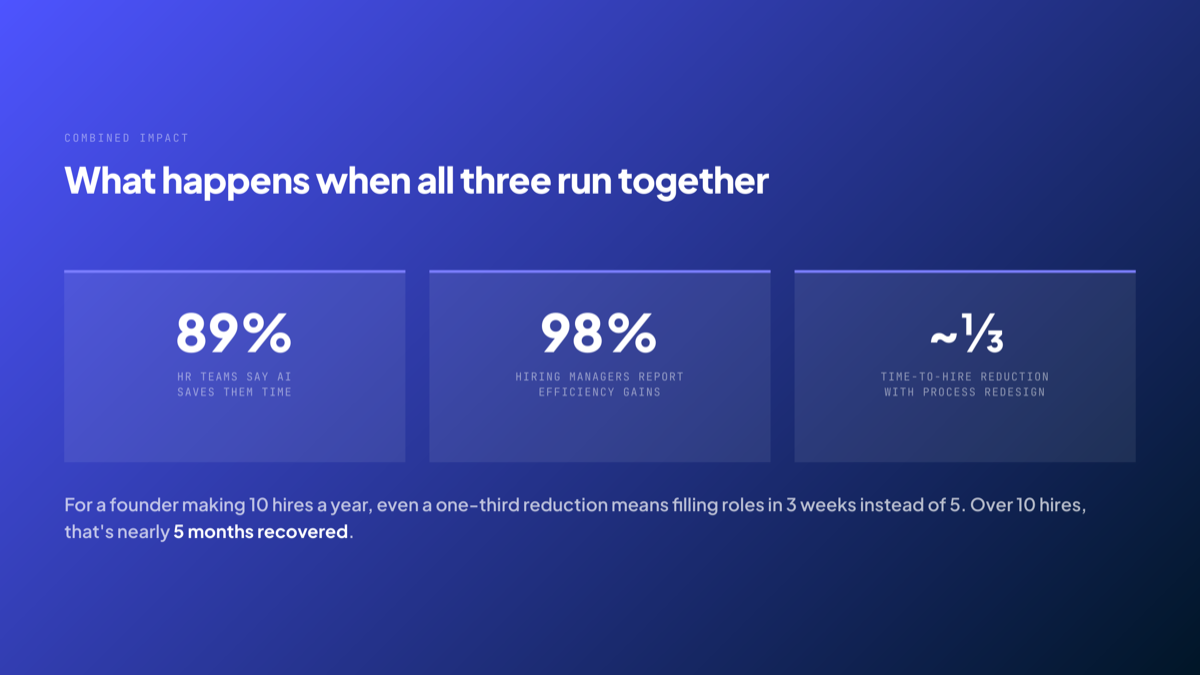
The numbers, with appropriate honesty about where they come from. Insight Global’s 2025 AI in Hiring survey found 98% of hiring managers using AI reported significant efficiency improvements. SHRM 2025 found 89% of HR teams using AI in recruiting say it saves them time or increases efficiency, and 36% say it reduces recruiting costs. Independent analysis suggests AI typically delivers around a one-third time-to-hire reduction when the underlying process is redesigned, with vendor-marketed numbers ranging higher (34% to 63%) for enterprise deployments.
All of these come from HR teams and recruiters at larger companies. Your results as a founder will be smaller in absolute terms, because you’re hiring less frequently, but proportionally more valuable, because the person doing the hiring is also running product, sales and operations. A day back during a hiring sprint matters more to a founder than to a 200-person company.
Don’t implement all three on day one. Start with Move 1. Validate the improvement on one real role. Then layer on Moves 2 and 3. The sequence matters.
The honest limitations
A credible 2026 article on AI recruiting has to cover what AI can’t fix and what it can quietly break. Skip this section in vendor marketing. Don’t skip it before your next hire.
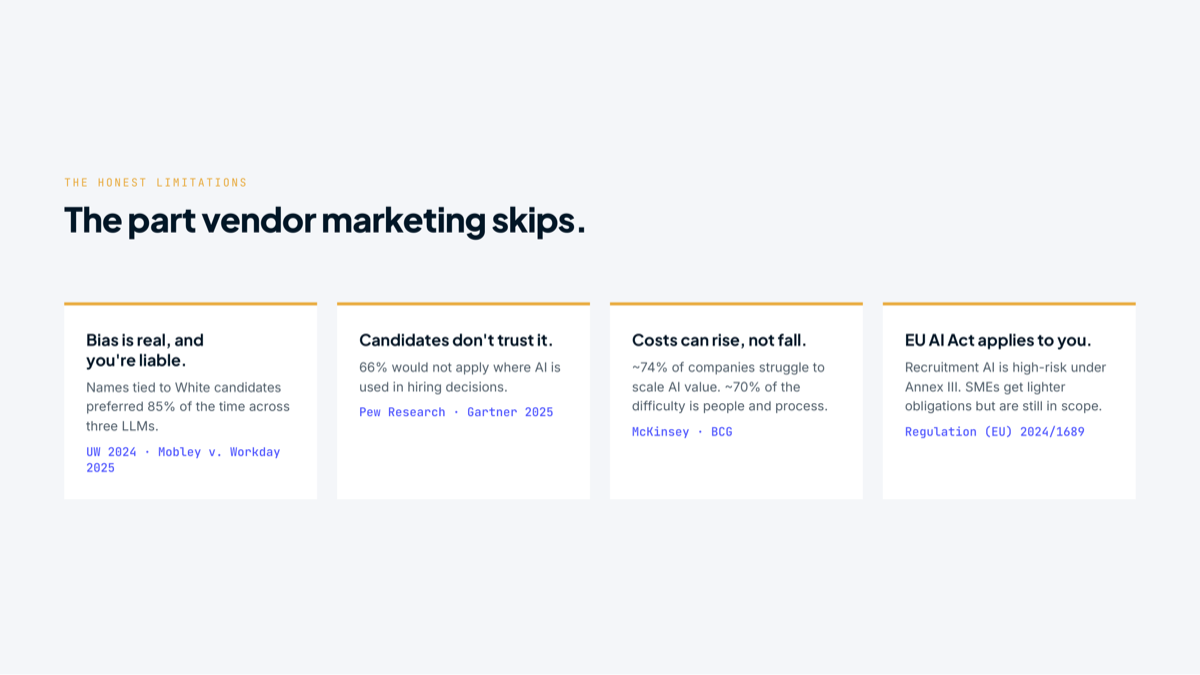
AI screening tools can be biased, and you can be liable. A University of Washington study by Wilson and Caliskan (presented at the AAAI/ACM Conference on AI, Ethics, and Society, October 2024) audited three large language models across 554 resumes and found names associated with White candidates were preferred 85% of the time, and male-associated names favoured 51.9% versus 11.1% for women’s names. Legal exposure is real and growing: in Mobley v. Workday (N.D. Cal., May 2025), a court ruled an AI vendor can be an “agent” of the employer for anti-discrimination purposes, certifying a nationwide ADEA collective action. “We used AI” is not a defence. Founders need tools that explain their scoring and can be audited.
Candidate distrust is real and measurable. Pew Research Center found 66% of US adults say they would not want to apply for a job where AI is used in hiring decisions. Gartner (1Q25 survey of 2,918 candidates) found only 26% of candidates trust AI will fairly evaluate them, even though 52% believe AI screens their applications. Founder takeaway: be transparent about where AI is in your process. Candidates increasingly notice, and increasingly care.
Costs can rise, not fall, if you only automate tasks. SHRM’s benchmarking shows cost-per-hire and time-to-hire both rose over the period AI adoption surged. Independent research finds time-to-hire gains stall when firms automate individual tasks without redesigning the underlying workflow. Roughly 74% of companies struggle to scale AI value, and ~70% of the difficulty is people and process, not technology. The implication for a founder: a tool layered onto a broken hiring process inherits the broken process. Decide what your process should be first; pick the tool second.
For European founders, the AI Act applies to you. AI used in recruitment (CV ranking, candidate scoring, interview analysis) is classified high-risk under Annex III of the EU AI Act. The original high-risk obligation date was 2 August 2026, and that deferral is now law: Regulation (EU) 2026/1744, the Digital Omnibus on AI, was published in the Official Journal on 24 July 2026 and entered into force on 27 July, moving the Annex III high-risk obligations to 2 December 2027. Either way, you, as the deployer of a third-party AI tool, carry obligations including human oversight, monitoring and logging. SMEs get automatic fine reductions (50% for SMEs, 75% for micro-enterprises) and lighter obligations than the AI provider, but you are still in scope. Treat this as a near-term compliance reality, not an enterprise-only problem.
None of this means “don’t use AI in your hiring.” It means use it deliberately, with tools that explain themselves, while being honest with candidates about how you’re using it.
Mistakes worth avoiding
Trusting AI scores without reviewing the reasoning. Scores surface candidates. Judgment closes them. Don’t skip the conversation because an algorithm said yes.
Signing annual contracts before validating. Most tools offer trials or pay-per-role pricing. Use one live search as your evaluation, not a demo.
Over-optimising for speed. Automated screening is invisible to candidates. A robotic rejection email isn’t. Candidates notice when they’re being processed rather than engaged, especially at the startup stage where culture fit is existential.
Waiting for perfection. The best time to adopt your first AI hiring capability was before your last painful hire. The second best time is now.
Where to start
Pick your most urgent open role. Use an AI tool to rewrite the job description. Compare it against what you had. That’s Move 1. It takes 30 minutes.
If the output is noticeably better - clearer, more specific, more likely to attract the right people - you’ve validated the approach on one role. Layer on Moves 2 and 3 from there.
Every hire compounds. The patterns you capture now feed better decisions on hire 20, hire 50, hire 100. Start small. Measure what changes. Build from there.
Try Avery
All three moves, in one place. Describe the role in plain language and Avery handles the sourcing, screening and salary intelligence so you can focus on the conversations. Get the taste of Avery for the next 24 hours. It’s on the house.
Frequently asked questions
What is AI recruiting technology and how does it work?
Machine learning and natural language processing applied to specific hiring tasks: writing job descriptions, parsing and scoring resumes, sourcing candidates through skills-and-trajectory matching, and benchmarking salaries against live market data. It analyses patterns across large datasets to surface insights that would take a human recruiter hours to compile. The result is faster decisions, not different ones.
When should a startup consider implementing AI recruiting tools?
Your second or third hire, or whenever you’re spending more than 5 hours a week on recruiting tasks. You don’t need a dedicated HR function first. The three-move framework in this guide is built specifically for founders hiring without a recruiting team. If you’re about to post a role, that’s the right time to start.
How do I identify where my hiring process is breaking down?
Track where time disappears. For most founders, it’s in three places: writing and posting the role (Move 1), screening applicants (Move 2), and determining the right offer (Move 3). Tools with recruiting analytics show you conversion rates at each stage - applications received, candidates screened, interviews conducted, offers made, offers accepted - so you can see exactly where you’re losing candidates or losing time.
Will AI replace my judgment in hiring decisions?
No. AI compresses the time it takes to reach a decision point. The decision still requires you. Culture fit, communication quality, motivation, long-term potential - AI informs these, it doesn’t resolve them. Use it to get to the right conversations faster, not to skip them.
What does this actually cost for a small team?
For a single capability, expect €15-€60 per month per tool. A founder stack covering sourcing, screening and scheduling typically runs €100-€500 per month. Many platforms offer pay-per-role pricing, which suits startup hiring patterns - sporadic, not continuous. The right comparison isn’t tool cost in isolation. It’s tool cost versus the value of your time and the cost of a bad hire (around 3x annual salary, per REC).
What are the most common ways this goes wrong?
Over-relying on AI scores without reviewing the reasoning. Setting screening criteria so rigidly that strong non-traditional candidates get filtered out. Adopting too many tools at once before validating that any single one improves outcomes. Using tools with opaque scoring that can’t explain their decisions, which creates both calibration problems and legal/bias risk. Start with one capability. Measure the impact. Then expand.